25: Is It Willpower or Is It Biology? What Protein Actually Does in a Perimenopause Body
Episode 25: Is It Willpower or Is It Biology? What Protein Actually Does in a Perimenopause Body
Listen:
Protein is everywhere right now, and everyone wants to know if they actually need it, and if the protein Pop-Tarts count. In this episode, I am getting into all of it.
We are working in the FUEL pillar of the Perimenopause Matrix today, and protein is one of the most important FUEL decisions you can make in perimenopause because it does not just affect your energy and body composition. It feeds directly into your REGULATE pillar too, meaning your blood sugar, your hormones, your mood, and your cravings.
I cover what protein actually is and why it matters more in perimenopause than at almost any other time in your life. I get into the SWAN study data on insulin resistance and why your metabolism is probably not broken. I talk about the muscle loss piece, the blood sugar piece, the hunger and cravings piece, and yes, I talk about the protein PopTart. I also share my own history with hypoglycemia and blood sugar chaos, because I think it matters for you to know that I have lived this, not just studied it.
By the end of this episode you will have a clear picture of what hitting your protein goal actually looks like, and a set of guidelines to experiment with in your own body.
“Willpower is a finite resource and it should not be required to make it to bedtime without a shame spiral.”
What You’ll Learn
- Why perimenopause increases insulin resistance and what the SWAN study tells us about metabolism, hormones, and blood sugar in midlife
- How protein supports natural GLP-1 production in your body and why that matters for fullness and cravings
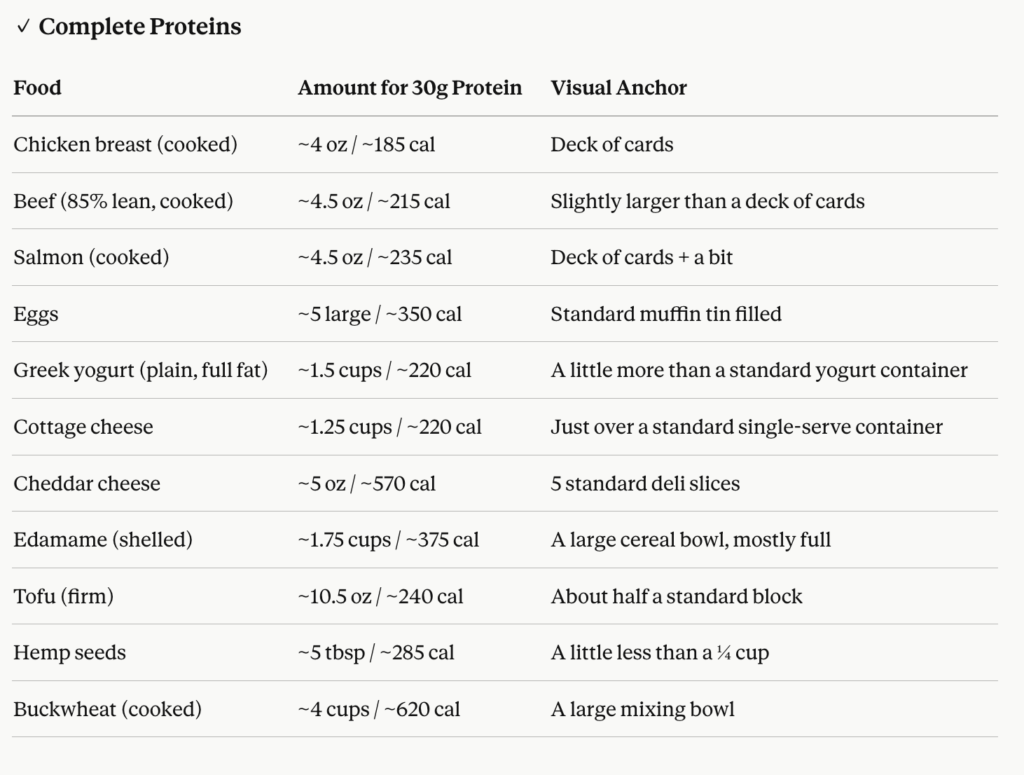
- What complete proteins are, why serving size tells the real story, and how to build a plate that actually hits your goals
- What the research says about protein in ultra-processed foods, and why the protein Pop-Tarts is not the same tool as a piece of salmon
- What women on GLP-1 medications need to know about lean mass loss and why protein is non-negotiable
Key Takeaways
✅ Start your day with 30 grams of protein and 5 to 9 grams of fiber. This combination is one of the most effective ways to stabilize blood sugar and reduce cravings later in the day.
✅ Higher protein and plant-forward eating are not opposites. You can eat a lot of plants and still hit your protein goals. It does not have to be either/or.
✅ 90 grams of protein per day is a solid, achievable starting point. The 1 gram per pound of body weight recommendation assumes active resistance training. If you are not there yet, 90 grams is where to begin.
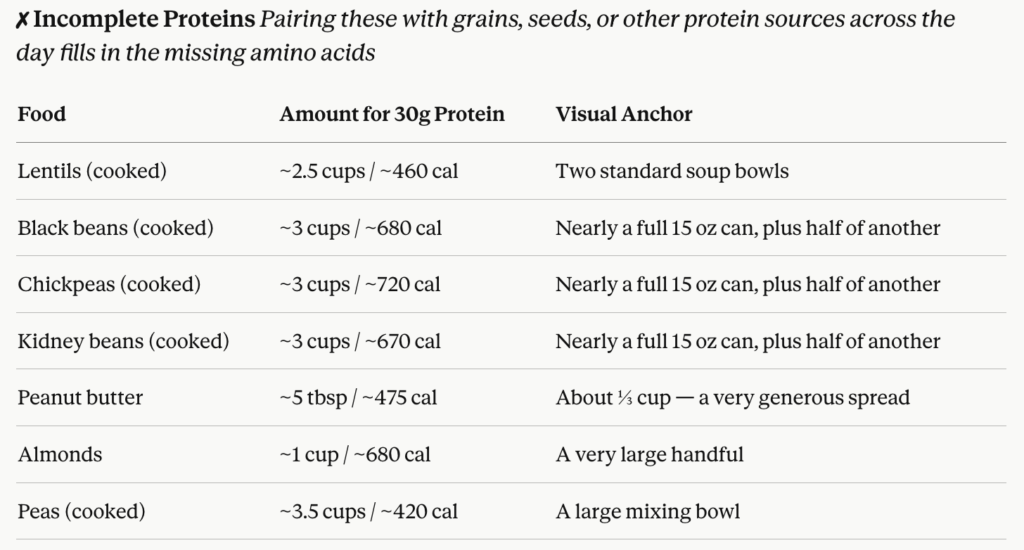
✅ Serving sizes tell the real story. Four ounces of chicken and 3 cups of black beans both have protein, but one is about 185 calories and the other is closer to 680. If you are building a plant-forward plate, you need to know that math.
✅ If you are on a GLP-1 medication, protein is non-negotiable. Research shows up to 40% of weight lost on semaglutide can come from lean mass. Adequate protein and resistance training are the two most powerful tools to protect your muscle.
Protein Breakdown
Ready to Understand What’s Actually Going On in Your Body?
If you’re tired of feeling confused about your symptoms and dismissed by doctors who say “everything’s normal,” my Perimenopause Matrix Lab Review is for you.
I’ll analyze your recent labs through the lens of perimenopause and create a personalized roadmap showing you exactly which pillar of the Matrix to focus on first. No more guessing. No more trying to optimize everything at once. Just clear answers and one actionable next step.
Learn more about the Matrix Lab Review →
Download my free Perimenopause Symptom Decoder and get clarity on what’s happening in your body. This guide helps you identify the subtle (and not-so-subtle) signs of perimenopause and understand which symptoms matter most.
You’re not crazy. You’re not broken. You’re not alone. And you absolutely deserve to feel like yourself again.
Related Episodes
Resources
- The Perimenopause Matrix™
- SWAN Study
- Donald Layman lab research
- Luc Van Loon research
- ENDO 2025 GLP-1 and lean mass study
- NIH Metabolic Ward Study
- For Hers Diet Trend Timeline
Full Transcript
Good morning and welcome back to Mornings with Megan. I’m Megan Pfiffner, Certified Nutrition Specialist and perimenopause nutrition expert, and I am really glad you’re here today because we are talking about protein.
And before you roll your eyes and say, yes yes I know I need more protein, hang on. Because I have some things to say that might actually change how you think about this.
Why This Episode Matters
Protein is having a moment. Again. And while I did eat a high-protein PopTart in the name of science for you, my sweet peri friend, I also want to be honest with you about what the research actually says, what it means for your perimenopause body specifically, and why your 1200-calorie salad phase was never a willpower problem.
That is what we are doing today.
Here is my thesis for this episode: protein matters more in perimenopause than at almost any other time in your life, and most women are not eating nearly enough of it. Not because they are doing something wrong, but because nobody told them what was actually happening in their bodies, or gave them a real picture of what hitting their protein goal actually looks like. By the end of this episode, you will have both of those things.
The Perimenopause Matrix and the FUEL Pillar
Before we get into it, a quick orientation for anyone new here. I work with women in perimenopause through a framework I developed called the Perimenopause Matrix. It has six pillars: Fuel, Move, Recharge, Regulate, Connect, and Clean. Today we are squarely in the FUEL pillar. But here is the thing about protein specifically: it is one of the few FUEL decisions that directly feeds into your REGULATE pillar, meaning your hormones, your blood sugar, your mood, and your energy. And if you have been listening to the Move series, you already know it is also the raw material your body needs to build and maintain the muscle we spent three episodes talking about. So protein is not a siloed conversation. It touches almost everything in the Matrix.
What Protein Actually Is
The basics first. Most foods are made of a combination of protein, carbohydrates, and fats. We tend to label things based on the macro that makes up the majority of the food. So we call steak a protein because it is mostly made of protein, and a potato a carb because it is mostly carbohydrate.
What exactly is protein? It is a chain of little amino acids, which are like legos that your body uses to build and repair. When you eat a protein, your body breaks it down into those little amino acid lego pieces and then uses them as needed. There are nine amino acids your body cannot make on its own. Those are called essential amino acids, and that is where the term complete protein comes from: a food that contains all nine. If you want to go deep on one specific protein that is often misunderstood in this context, go back and listen to the collagen episode. I will link it in the show notes.
You can get all of your essential amino acids from combining different plant foods across the day, which is what many plant-forward eaters do. We will get into that in a minute.
Why Perimenopause Changes the Protein Equation
Here is where it gets really relevant for you specifically.
One of the most common things I hear from the women I work with is that their metabolism feels broken. Like they are eating the same way they always have and their body is just not responding the same way. And the research-backed answer to that is: your metabolism is probably not actually broken. What the SWAN study, one of the largest long-running studies on women’s health, showed us is that as hormones start to decline in perimenopause, women become more insulin resistant, independent of age and independent of weight. Your estrogen and progesterone are not just reproductive hormones. They play a real role in blood sugar regulation. When they become erratic and start to step down, blood sugar control gets harder.
I want to pause here because this connection does not get talked about enough, and it should: hot flashes, the symptom most associated with menopause, are directly correlated with higher insulin resistance. So this is not a fringe metabolic conversation. It is the center of the perimenopause experience for a lot of women.
The second thing happening in perimenopause is muscle loss. We start losing muscle mass in our 30s and the rate accelerates through perimenopause, in part because estrogen is directly protective of muscle tissue. Researchers like Dr. Don Layman at the University of Illinois, whose lab is foundational to how we understand protein metabolism today, and Dr. Luc Van Loon at Maastricht University, whose work focuses specifically on muscle protein synthesis in aging adults, have both contributed to the evidence base that tells us: adequate dietary protein is one of the most powerful levers we have for preserving muscle mass, and the threshold is higher than most people think. For everyday women, not competitive athletes, what moves the needle is not precise protein timing windows. It is total daily protein, distributed across meals, over a 24-hour cycle. That is my clinical north star for this.
So you have two things happening in perimenopause that protein directly addresses: rising insulin resistance and accelerating muscle loss. That is the case for prioritizing protein right now.
Blood Sugar, Fullness, and Cravings
Blood sugar is usually part of the picture when women come to see me. This happens even when women are eating healthy diets. And protein is one of the best tools we have for this. If I can get a client to start her day with 30 grams of protein, and ideally 5 to 9 grams of fiber, we are off to the better energy races.
Here is why that works physiologically: protein is satiating, meaning it keeps you full. It has minimal impact on blood sugar compared to carbohydrates. And lower glycemic meals, the ones higher in protein and lower in refined carbs, actually stimulate more natural GLP-1 production in your body. GLP-1 is a hormone that slows how quickly your stomach empties, which means you stay fuller for longer. Your body is doing this naturally when you feed it protein and fiber. That is not a supplement. That is just food.
Fullness can also be an issue for clients who feel like they are always hungry or always craving something. And this is where I want to say something important. A lot of the women I work with came of age in the low-fat, low-calorie era. They are trying to get away with 1200 calories a day, simple salads for lunch, and they are ravenous by dinner and craving sweets after dinner. And then they feel like that pattern is some kind of moral failing or a lack of willpower.
It is not.
Willpower is a finite resource and it should not be required to make it to bedtime without a shame spiral.
I lived in that hunger and craving cycle for years. I have always had a very robust appetite, and when I was younger, cravings all the time. I was diagnosed with hypoglycemia and the standard recommendation at the time was to eat every two hours. I was 19 and honestly delighted by this. I had snacks in my bag at all times and dutifully ate crackers, chips, pretzels, Snickers bars, tacos, instant noodles every two hours to keep myself from crashing. You can see where the problem was.
This was a serious blood sugar problem and I had zero education on what caused it, how to stop it, or how to get out of the every-two-hours cycle. I would be starving an hour after I ate, feel like I was going to pass out on the train, and get so irritated and grumpy and anxious if I did not have food. It was a real problem, and I truly understand the pain of anyone in that cycle. Needing, not wanting, needing to eat some specific sweet thing that you are willing to put on 15 layers to walk to the store for in the dead of winter? That says it all.
When I finally started addressing this, I could not tell the difference between hunger and thirst and had no idea how to feed myself. None. I did not attend the class called how to eat like an adult, and my health suffered for years until I was able to connect the dots with help from some incredible people.
What the Protein PopTart Actually Does
So what does all of this mean for the protein PopTarts and donuts and sparkling waters and candy bars?
Here is my honest answer. Protein is really great at helping you feel full and reducing later cravings, but the food environment matters. Research, including a highly controlled NIH metabolic ward study I will link in the show notes, has shown that higher protein combined with ultra-processed foods actually leads to more food being eaten, not less. The blood sugar and satiety benefits of protein diminish, and sometimes disappear completely, in the context of ultra-processed foods.
The protein PopTart is not going to do what a piece of salmon does. That does not mean you cannot have it. But remember that it is an ultra-processed food, and while the protein content may help modestly with blood sugar stability and hitting your daily total, it is not the same tool.
Yes, of course I eat the protein donuts that Freddie brings home as treats. But that is what they are: treats. Just like a fun candy bar or dessert somewhere special.
Send This to a Friend
If you have a friend who has been telling herself she just needs more willpower around food, send her this episode. Hit the share button right now in your podcast player and forward it to her. What she is dealing with might be biology, not character.
What I Have Learned: Experiments, Not Prescriptions
After years of working through this myself and then doing it clinically with women in perimenopause, here is where I have landed. I am offering these as experiments, not prescriptions. You are the expert on your body.
Higher protein and plant-forward are not opposites.
I hit around 120 grams of protein a day and sometimes close to 45 grams of fiber from whole plants, not fiber supplements. That is what works for my body. But the point is you can eat a lot of vegetables and plant foods and also eat animal protein. It can be an AND, not an either/or.
Serving size matters more than most people realize.
Lots of foods have protein in them, and how you choose to hit your protein goals is up to you. Poultry, seafood, meat, eggs, dairy, soy products like tofu and edamame, hemp seeds, and buckwheat all fall into the complete protein category, meaning they contain all nine essential amino acids. But you also need to consider what it actually takes to hit 30 grams from each source, because the serving sizes are not equal. I am going to put a full breakdown in the show notes, but here is a quick preview: 4 to 4.5 ounces of animal protein and fish gets you there. So does 5 large eggs, 1.5 cups of Greek yogurt, or 10.5 ounces of tofu. Hemp seeds get you there in about 5 tablespoons, which is actually quite doable. And then on the plant side, you are looking at 2.5 cups of cooked lentils, 3 cups of beans, or 3.5 cups of peas. Think about it this way: 4 ounces of chicken and 3 cups of black beans are both protein sources, but one is about 185 calories and the other is closer to 680. Neither is wrong. But if you are building a plant-forward plate and trying to hit 90 grams a day, you need to know that math going in, because it changes how you plan your meals.
You are the expert on your body.
You will hear a lot of practitioners, myself included in other episodes, recommend 1 gram of protein per pound of body weight, or per pound of ideal body weight if body composition is a goal. That recommendation assumes you are actively resistance training and doing some form of cardio. If you are not there yet, 90 grams is a solid, achievable place to start. And for anyone on a GLP-1, that 90 gram floor is non-negotiable: it is the minimum I use as a target to protect lean mass while the medication is doing its job.
There is no universally right way to eat, and I have yet to move anyone below 90 grams, but I am sure that day will come.
The ethics and access conversation deserves more than a headline.
There is an incredible amount of nuance in the conversation around protein sourcing and environmental impact. It is not black and white, and it is often hijacked by clickbait that gets everyone worked up. You can be an ethical carnivore and an unethical vegan. One of the things that frustrates me most in the ethics and environmental debate is that access gets completely lost. It is not cheap, easy, or convenient to be a healthy plant-based person. It requires time, energy, money, quality ingredients, education, supplementation, and regular lab testing to do it well and safely. I grew up in a food environment with real access and real choices, and it still took me years and a graduate degree to figure this out. Expecting someone without those resources to take on the burden of ethical protein sourcing is tone deaf and unhelpful. We need to address food environment and food access before we can put that weight on people who are already navigating food insecurity.
A Note for Anyone on a GLP-1
One more thing before I go, and this is specifically for anyone on or considering a GLP-1 medication. Research presented at the Endocrine Society’s 2025 annual meeting out of Massachusetts General Hospital and Harvard Medical School found that up to 40% of weight lost on semaglutide can come from lean mass, and that women and older adults are at highest risk for that muscle loss. Resistance training and adequate protein intake can significantly offset this. If you are on a GLP-1, protein is not optional. It is what protects your muscle while the medication does its job. I covered the resistance training side in episodes 23 and 24, and both are linked in the show notes.
Where to Go From Here
If today’s episode made you want to actually look at your protein intake, the Perimenopause Symptom Decoder on my website is a great place to start understanding where your body is right now. And if you want to go deeper, the Matrix Lab Review is a 60-minute session where we look at your labs through a perimenopause lens and build a real nutrition strategy around what your body actually needs. Both links are in the show notes.
Thank you so much for being here. I will see you next Wednesday.