
The Earthquake, the Eczema, and the Warrior: Natalie Novak’s Full Story (Part 2)
In this episode of Mornings with Megan, I continue my conversation with Natalie Novak, celebrity aesthetician and co-founder of KPS Essentials, picking up right where Part 1 left off. This episode touches both the Clean and Connect pillars of the Perimenopause Matrix: the ingredients on our skin, and the community and care we build around the hardest parts of our health.
We get into why autoimmune skin conditions like rosacea, eczema, and psoriasis show up so much more in perimenopause, and why they so often travel together. Then Natalie takes me all the way back to the moment that changed her life, a bottle of product, a 1987 earthquake, and a hole in the carpet, through building a skincare line from her kitchen blender to a company trusted in oncology care. We close with her partnership with the Hello Gorgeous Foundation, and honestly, some of the stories she shares stuck with me long after we stopped recording.
“The skin is telling a story of what’s happening internally.”
What You’ll Learn
- →Why autoimmune skin conditions like rosacea, eczema, and psoriasis spike in perimenopause
- →Why these conditions tend to show up in multiples rather than alone
- →How Natalie’s own path, from an earthquake to a horse named Boogie, led to building KPS Essentials
- →What building a truly clean, food-grade skincare line from scratch actually requires
- →How the Hello Gorgeous Foundation partnership supports women navigating cancer
Key Takeaways
- ●Skin autoimmune flare-ups are often a visible signal of internal inflammation, not just a surface problem
- ●Nervous system regulation (breathwork, Yoga Nidra) is a legitimate part of a skin health plan, not a separate wellness add-on
- ●Clean, food-grade formulation is harder and slower than conventional formulation, which is part of why so few brands do it
- ●A product’s safety in sensitive populations, like oncology patients, is a meaningful signal of overall formulation standards
The Perimenopause Matrix Lab Review
I’ll analyze your recent labs through the lens of perimenopause and create a personalized roadmap showing you exactly which pillar to focus on first. No more guessing. Just clear answers and one actionable next step.
Learn more about the Matrix Lab ReviewPerimenopause Symptom Decoder
Download the free guide and get clarity on what’s happening in your body. You’re not crazy. You’re not broken. You’re not alone.
Get the free Perimenopause DecoderRelated Episodes
WTF Is Happening to My Skin? Glycation, Melasma, and Clean Ingredients with Natalie Novak (Part 1)
Why Your Protocol Isn’t Working (And It’s Not Your Fault)
Overwhelmed in Perimenopause? Here Is Exactly Where to Start
I Spent a Year Looking for a Doctor Who Would Believe Me. This Is What I Found.
Resources
- –KPS Essentials (use code MWM20 for 20% off)
- –KPS Essentials on Instagram
- –Hello Gorgeous Foundation
- –EWG.org Skin Deep Database
- –Nervous System Support episodes
- –NSDR with Andrew Huberman (10 minutes)
- –Yoga Nidra on Insight Timer (22 minutes)
- –Box Breath: exhale deeply, inhale through the nose for four counts, hold for four, exhale through the nose for four counts, hold for four
- –4-7-8 Breath: inhale through the nose for four counts, hold for seven, exhale strongly through pursed lips for eight, repeat two to four times
INTRO
Welcome back, I’m Megan Pfiffner, nutritionist and perimenopause decoder, back with you this week.
If you caught part one, you already know why I could not stop talking about this conversation. We spent last week with Natalie Novak, celebrity aesthetician and co-founder of KPS Essentials, Kindness Powered Skincare, breaking down what perimenopause actually does to our skin: the glycation, the oxidative stress, how to rebuild a routine that works with your changing skin, and how to use the Environmental Working Group to actually know what is in your products. We also got into melasma and what my retinol A friends need to know about sun protection.
Today we are picking up right where we left off. Natalie is walking us through what is happening with autoimmune skin conditions like rosacea, eczema, and psoriasis in perimenopause, and why they tend to show up together. Then she is taking us all the way back to the moment that changed the course of her life: an earthquake, a bottle of product, and a hole in the carpet that made her ask what these chemicals were doing to her skin. From there we get into her partnership with the Hello Gorgeous Foundation, which supports women going through cancer treatment, and honestly, some of the stories she shares stuck with me long after we stopped recording.
Natalie, welcome back to Mornings with Megan.
Megan: Earlier you mentioned autoimmune conditions, and I’m wondering what you’re seeing with rosacea, eczema, or psoriasis in this perimenopause age range.
Natalie: Here’s what’s really interesting. In the treatment room, we are seeing so many more dermatological cases of rosacea, eczema, acne, even psoriasis. I believe the reason we’re seeing so much more of this is because of environmental toxins. We’ve got all kinds of things contributing, I don’t know if 5G is contributing, I’m not a scientist, but I don’t know if it’s contributing, but I believe it may because we’re seeing so much more of these conditions. We’re seeing people who used to tolerate certain products and now they can’t. They’re more sensitive, having a lot more reactions to the skin. I feel like the body is out of balance, and things are really shifting.
We used to see some of this in the treatment room when I worked for a dermatologist, but nothing like we’re seeing today. Think about different responses the skin is having because of sensitivities, because our nervous system isn’t regulated as easily as it used to be, because of all these different environmental toxins. It just keeps adding up, and the problem is we’re accumulating more and more toxins in the body, but our body can’t keep up with getting rid of them. So it’s so important to continue to move all day long and not just sit at a desk, because that stagnation isn’t healthy for us.
Megan: Yeah, we do want to keep everything moving. I love that you talk about detox, because that’s such an important piece of this puzzle. Our bodies naturally detox, we don’t need to be doing detox cleanses and juicing, but doing things like you’re saying, moving our bodies, which helps with lymphatic drainage and helps our bodies get things moving, especially in our GI system. That’s part of our detox. Any time you have a bowel movement, any time you urinate, that’s our body naturally detoxing. We have a liver and a kidney whose job is to package things up we don’t want and expel them. So we need to support those systems naturally to help with this oxidative stress piece and get rid of that toxic burden. You just mentioned our body’s nervous system not regulating as well. I see this too in perimenopause, especially earlier when progesterone starts to decline. Do you notice something different in women when they start to lose their progesterone as opposed to later in perimenopause when their estrogen is also declining?
Natalie: I do. I notice their anxiety levels are higher, their nervous system isn’t regulated, they’re not sleeping well, everything feels out of balance. Helping them find tools to get themselves back in balance is key. Breathing techniques are fabulous, box breathing is super helpful when you’re just sitting on a plane and suddenly feel anxious for no reason. You use that tool to get yourself feeling better. Yoga Nidra is a wonderful tool too, where you don’t have to move your body, you simply lay there and breathe and become aware of different parts of your body, it’s phenomenal for bringing the body back into balance. You’ve got to find some tools for yourself as you’re going through this, because it is stressful, the body’s changing, and it’s not exactly fun. You never know exactly what’s going to happen, but you’re going to see these shifts. Your skin is going to feel like alligator skin, rough and dry. But it’s okay, it’s just part of being a woman, and we find ways to work through it.
Megan: It is okay, it is part of the process, and I will link in the show notes to all of our nervous system support episodes, because I agree with Natalie and definitely suggest lots of different breathwork and tools to regulate your nervous system in this phase of life, especially in early perimenopause when progesterone is starting to step down.
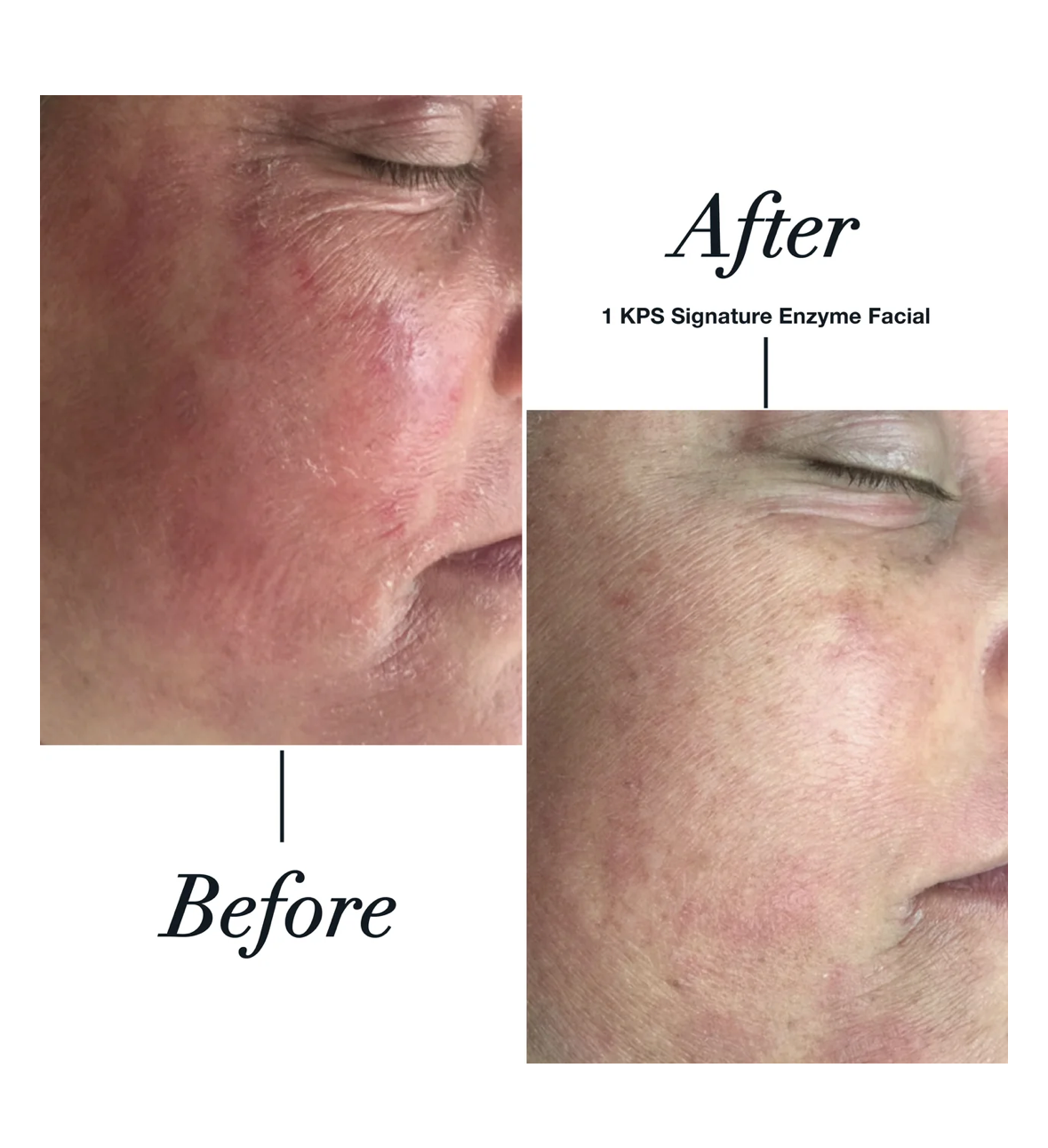
When we first met, you showed me some really striking before-and-after pictures with your product addressing rosacea, eczema, and psoriasis. What is a realistic timeline for someone starting off with some of that on their face, and how soon could they expect to start seeing some relief?
Natalie: Megan, that’s an excellent question, because here’s what’s going on: the skin is telling a story of what’s happening internally. If you have a bad case of eczema, there’s probably something going on with your gut health too, because internally there’s inflammation, which is like a fire within the body, and you have to figure out how to put that fire out. That’s why functional med docs are great, because they can help us work internally and externally. To answer your question specifically, it’s going to be different for everyone depending on gut health, and whether there’s a medication that might be causing the problem. It can happen as soon as 24 to 48 hours, and sometimes it takes a month or two, it just depends.
Some of the photos I shared with you, one woman had a decades-long battle with eczema. When she came into my treatment room and I put my hand on her face, it was literally red hot, you can imagine the amount of inflammation under the skin. We refer to it in the industry as inflammaging, because inflammation is aging the skin. This particular woman had been on Dupixent for decades as well as prednisone, and it wasn’t even really keeping it at bay, she was still having a real problem with it. When we treated her with our products and she got that facial, after one hour, you could see the redness dissipate. When you feel the skin after, it’s cool, because we’re treating the skin with products focused on inflammation and helping the skin reverse that. It’s dependent on the condition, but it could be very quickly, that was one hour and she got that result. She ended up quitting her job and coming to work for us, in sales, because it changed her life. She had never had something like that happen to her, because she wasn’t able to date, she would go home from work and scrape her face off because it was so itchy and irritated and dry. She had a transdermal water loss issue, and our products helped create water storage within the cells so it doesn’t evaporate off the surface. That was a game changer for her.
Megan: I can’t even imagine that level of eczema on top of getting to a point in life when we’re already dehydrated, and like you were saying earlier, autoimmune conditions, especially skin autoimmune conditions, are more likely to pop up in perimenopause, and a lot of times they travel in multiples. It’s not usually just eczema, it’s eczema and psoriasis, or eczema and RA, or something else. It’s great to know that the product itself is addressing the underlying cause, that inflammation, which we can have in our guts and all over our body, but if you can directly address it topically from the skin perspective while also dealing with the internal piece, I’m sure the healing is so much faster.
Natalie: It is, absolutely, one hundred percent.
Megan: I want to dig a little into your story, because you are so clearly passionate about your product and how it helps women. What was the moment that made you decide to start formulating your own products?
Natalie: That’s a great question. I’ve always loved skincare, so in college I was working at Nordstrom, selling high-end skincare, living in Southern California. There was a big earthquake one morning, and about an hour after, I got to work and went up to the stock room to replenish stock, and I noticed one of the products I’d been using, a product I feel like every American woman has used, had fallen and broken, and it actually ate through the carpet as well as the carpet padding, exposing a hole of cement the size of a Frisbee. I was so shocked. I immediately thought, how is this legal? What is this doing to my skin? How will this affect the environment? I couldn’t even wrap my head around it. So the first thing I did was buy the Cosmetic Ingredient Bible, which told me everything about every ingredient in all these different products and why it was used. That opened my mind to want to become an aesthetician. As I learned more, I wanted to learn more about the body, so I became a massage therapist. That’s when I learned the FDA had not regulated the Cosmetics Act since 1938, which means huge conglomerates can do whatever they want. So many of them are focused on the marketing and making money, not on what’s actually in their products.
Here’s the ironic truth: two months later, my grandmother was diagnosed with breast cancer. Her physician at the time told her it could have been caused by all the hormone-mimicking chemicals in cosmetics, he was way beyond his time. I thought, that’s red flag number two, there’s a gap in this industry. I was young at the time, and fast forward several years, I’m married, living in Michigan on my farm, eleven acres, two kids, alpacas, seventy-five chickens, living this very organic, healthy lifestyle. My daughter wanted to paint her nails every day, and I’m thinking, Kiki, you just collected eggs from the chicken coop and vegetables from the garden, and now you want to put toxic chemicals on your nails? No, we’re going to try to find something clean. I started shopping, I thought Whole Foods would have something, but there was nothing on the market back then. She wanted a spa-themed birthday party, so I figured I’d just make all these products myself. I started making them in my kitchen in my blender with things I’d grown on the farm, and it turned into a product I named after her, Kiki Pure and Simple. We launched in Whole Foods in 2010. Shortly after I thought, this is a fun tween line, but what about me, I’m approaching 50 and I need to do something rapidly here. I started calling different chemists and went on this quest for a couple of years, and they laughed at me. Every single one said the same thing: find a new hobby, you cannot do this without harsh chemicals, that’s just the way it’s always been done in skincare. I thought, there’s this burning desire in my soul telling me to keep going. As hard as it was, I did.
Then in 2012 I met Ron Webb. He had been mapping the genome with his mother back in the early 90s, and had worked with her in animal wound care, because she had an Arabian horse farm in Payson, Utah. Her favorite horse, Boogie, she could snap her fingers and he’d come running from the pasture. He was very special, but he got spooked one night and got a huge gash in his shoulder. The vet came out the next morning and said, I hate to tell you, Emma, but you’re going to have to put Boogie down. She said, absolutely not, we’re going to figure out how to save this horse. So Ron and his mother teamed up and figured out all the nutrients this horse needed, created a salve, that’s actually part of what our DermaNu Technology is today. Boogie was saved. When you think about utilizing things straight from the earth, Mother Nature provided all this nutrition, it’s there for us, we just need to take advantage of it.
Megan: This is giving me chills. This is such a great story, and it seems like this has been a long journey. What is one of the most challenging parts of building a clean, food-grade line from scratch, especially when we think about the hurdles you had to jump over from formulators telling you it couldn’t be done without chemicals?
Natalie: It’s really difficult, because in the industry most brands will buy ingredients from cosmetic ingredient banks, where it’s pretty much all the same stuff, but we actually make our own ingredients. It takes us months to formulate and do these things, and it’s challenging because we’re pioneering our own way through this, we’re not following what everybody else does, which means it’s a whole lot more challenging in relation to controlling mold and things that want to grow in products, because there’s so much nutrition, and anytime there’s nutrition, you’re going to find mold and different bacteria. We have to really be mindful of maintaining those standards and all the other things. But even though it’s the harder path, it’s the best path, because the reason we’re doing this, what really brought Ron and me together, is that we both have such a passion to help others.
The fact that we’ve been able to donate to the Hello Gorgeous Foundation to help women with all types of cancers for the last nine years has been such a wonderful journey with them, because when you take a woman going through chemotherapy and her body is reacting, her skin is literally purging these chemicals, and it’s extremely dehydrated, because that’s part of what chemo does, it dehydrates your body. The chemicals are coming out and she’s got a massive rash, or she’s developing rosacea or eczema, and because our products are so nourishing and so high in nutrients, minerals, and vitamins, it actually helps their body bring their skin back to homeostasis, so they can have healthy skin and aren’t fighting that along with everything else they’re dealing with. That’s why we love what we do, because we can help change lives, and that’s really at the end of the day why we’re doing this.
Megan: Tell us a little more about Hello Gorgeous and your Hello Gorgeous Foundation partnership.
Natalie: Kim Becker is the founder, she’s based in Elkhart, Indiana, and she’s got the biggest heart. She has wanted to help women with all types of cancer, so anybody who can come to Hello Gorgeous, they’re going to help them with whatever challenge they’re facing. She is just amazing, she’s everybody’s cheerleader, she helps them through whatever it is, whether they need to get fitted for a wig, or clothing, or support and education, or products, they supply them with Kindness Powered Skincare. It’s just a beautiful organization and I love what they do.
Megan: It sounds incredible, and it’s so special that you and Ron have been able to partner with them for so long, because oncology, and anything we have to face like that, is such an uphill battle and so isolating. Being able to have community, support, and someone who can come back to where you are and say these products are safe, you can use them while you’re going through care, that’s a big thing. Even supplements, we know the FDA isn’t regulating supplements, but that’s a big thing when you go through cancer care, you have to be very careful about what’s going in and on your body to make sure you’re not having interactions. Having a product that heals the skin from the outside must be such a relief for so many of those women, because that visual, being on the outside of your body while you’re going through chemo, everyone’s seeing you interacting with them, whether it’s the hair loss or the skin on your face when you’re trying to get through your day, having something to alleviate some of that must be such a wonderful relief.
Natalie: It is. And Kim Becker will tell you, she has tried this product on thousands of women, and not one of them has had a reaction to it. That’s why they love partnering with us, because we’re actually adding to the nutritional value their skin needs. We don’t realize environmental toxins are robbing our skin of nutrients, and we’re walking around malnourished. It’s really important to choose something that’s feeding your skin rather than taking away from its nutritional value.
Megan: Yes, and that’s how I want women to treat their bodies, not just their skin. We want to add nutritional value, not take away from it. Is there anything you would have done differently, knowing what you know now?
Natalie: As far as the business goes, from everything I’ve done, when you’re in business you have to fail your way to success. Failure is a really good thing, because you’re always learning when you’re failing. If you learn how to fail fast, you’re learning more. I don’t know that I would do anything differently, because I feel like the universe has put me on this path for a specific reason, and I’m here to help women and anybody with problematic skin. I feel like I wouldn’t do anything differently, because I’m just guided every day, depending on who comes into my path.
Megan: I agree with you, I feel very called and compelled to help women, that’s what I want to do. If I didn’t have the life I have, I wouldn’t have gotten to this place, so it seems silly to think about changing it. But sometimes we do have learnings where we think something might have made it easier. I think what you said, the failing part, is where we learn so much, and if we take away those learnings, that maybe doesn’t get us where we needed to go to begin with.
Natalie: Exactly, one hundred percent.
Megan: Are there any stories that have stuck with you while working with KPS, a life that has changed, a woman who’s done something different, similar to your rosacea story, that you want to share?
Natalie: Yes. There’s a woman, her name is Tiffany, she is an absolute warrior. She came to me from Hello Gorgeous. She started out with non-Hodgkin’s lymphoma, blood cancer, and had to go through chemotherapy. I didn’t realize this, but apparently chemotherapy exacerbates melanoma, so she ended up losing her nose and had to get a prosthetic nose. What happened was she ended up with horrible scarring around her face, and she’s this beautiful young woman with three little girls, gorgeous, and to see her with these horrible scars is terrible, thinking about her looking in the mirror every day and having to look at these scars.
So when Kim Becker called me and said, I’ve got this woman, I think you can help her, will you please try, I said, of course, send her to me, let’s see what we can do. Luckily she lived about an hour away and could drive here, and I was able to do treatments on her. After about four months of facials on her and her using our products at home, her scars are gone, which is so remarkable.
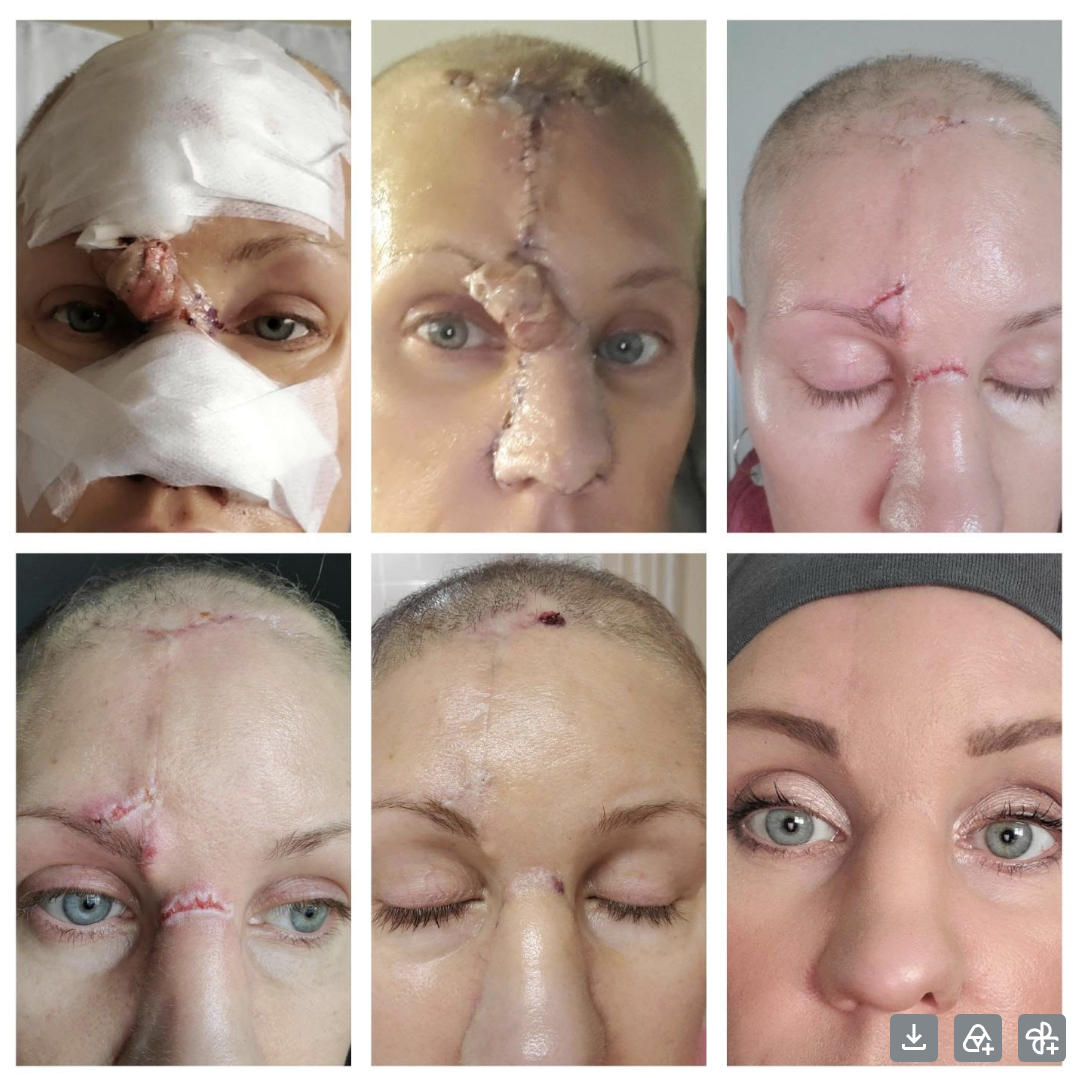
She’s so grateful, and she loved that she could get rid of those scars but also feel good about what she was putting on her skin as she was going through cancer treatment. This has been a long battle for her, but it’s such a beautiful story watching her, she’s such a brave woman, and I truly mean it when I say she’s a warrior, because she has maintained this positive perspective about everything. She just knows she wants to get her kids through high school, wants to be there for them. She is the most determined woman, I look at her on Instagram and get so happy because she’s living her best life, traveling to Hawaii, hiking, doing long trips with her husband and children. She’s such a testament to what positivity can do for you. It’s a remarkable story, and I was really honored to be part of it.
Megan: She sounds like an absolutely incredible woman, and I’m glad you were able to have that experience, because that’s sort of why you got into this, right, this is why you were there to be able to help women do things like that.
Natalie: A hundred percent, yes.
Megan: What are three things you want our perimenopause friends to remember about their skin this week?
Natalie: Make sure you remember your skin is your largest organ, and what you put on it is going to affect all of you. Sunscreen is a big thing, it’s important to protect your skin, that’s another part of the aging process. Also nourish your skin, make sure you’re cleansing before bed, and nourish it with ingredients that are safe and healthy. Do your homework, choose products that are really good for you, so you can feel good about what you’re putting on your skin every day.
Megan: So we’re going to wash our face for sure, we’re going to make sure we’re nourishing our skin through our food and the way we take care of it, we’re going to make sure we’re putting on sunscreen, and then we’re going to use that Environmental Working Group app to check our products, starting with our top five, and we can add from there, just to make sure we’re aware of what types of chemicals we’re putting on our face, because we really don’t want to add any premature aging, glycation, or oxidative stress when we don’t have to.
Natalie: Exactly, I love it, you nailed it.
Megan: Where can people go to find you and KPS?
Natalie: We’re at KPSessentials.com. We’re also KPS Essentials or Kindness Powered Skincare on Instagram. I’m on Instagram as your_skinhealth_guru. I do have a little special gift for your listeners, if they go to kpsessentials.com and use coupon code MWM20, mornings with Megan twenty, that’ll give you a twenty percent discount.
Megan: That is so generous, thank you so much, Natalie. You gave us a lot of food for thought, and thank you for all of the stories that you shared and the time that you spent with us this morning.
Natalie: Well, it was lovely being here, thank you so much, I really am grateful to you for having me on today.
Megan: Thank you all for joining us for this amazing conversation with Natalie. We’ll see you next Wednesday for your next episode of Mornings with Megan.